Imagine the following situation: You manage a beautiful guest house in the mountains. You upload stunning photos to Facebook and Instagram - the sunrise from the terrace, the cozy fireplace, the homemade breakfast. The comments pour in: "Wonderful place!", "When can I book?", "How much is it for a weekend?".
And here the chaos begins. You open Messenger - 47 unread messages. "Do you have a free room for July 15-17?", "Do you accept dogs?", "What is the price for 4 people?". You start answering everyone manually. You check the notebook with reservations. Someone asks about September - you have no idea what will be free after 4 months. Someone else wants to pay online - you send them an IBAN in private messages.
After 2 hours of replying to messages, you realize - this is not a business. This is a full workday as a chat operator.
That is why thousands of hoteliers and owners of guest houses across Europe understood one simple truth: social networks are a great display window, but a terrible reception.
The story of Maria and the disappeared Facebook page
Maria has been managing a family hotel in Bansko for 8 years. She had 15,000 followers on Facebook, built with years of work. Every winter she posted photos of the snowy peaks, the cozy rooms, the happy tourists. Every reservation went through Facebook Messenger.
One morning in December - in the middle of the ski season - she opens her phone and sees a message: "Your account has been disabled for violating Community Standards". Without warning. Without explanation. The profile simply disappeared.
It turned out that a competitor from a neighboring hotel had sent several false reports. Facebook automatically blocked the profile. Although it was later restored, Maria lost 3 weeks of the most profitable period of the year. Hundreds of potential guests looked for her, but couldn't find her.
This is not a made-up story. It happens every day to thousands of businesses around the world. Because when you build your business on Facebook or Instagram, you are building on foreign land, by foreign rules.
You can be blocked because of a false report, an automatic filter, a change in policies, a system error, or even a complaint from an unhappy customer. And this can happen exactly when you need reservations the most.
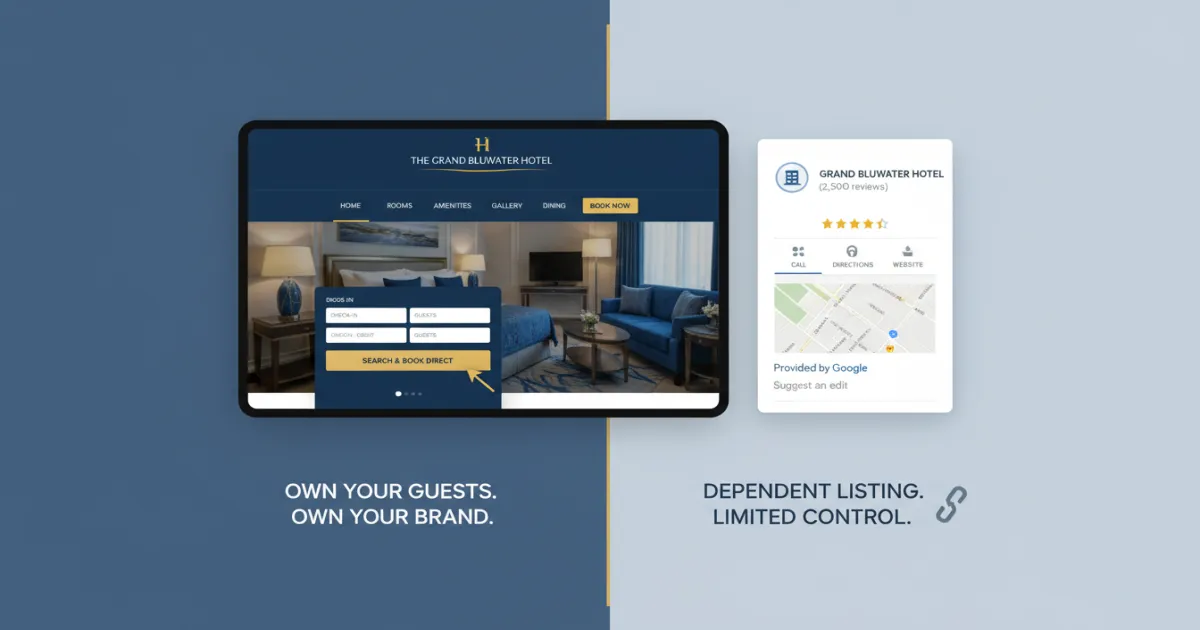
Your own site is yours. The domain is yours. The content is yours. No one can take it away from you.
"Sounds great! Do you have a site?"
Do you know that moment? Someone asks you about the hotel. You describe the beautiful location, the comfortable rooms, the homey atmosphere. Their eyes light up: "Sounds great! Do you have a site so I can look?"
And here you say: "No, but we have a page on Facebook."
You see a slight change in their expression. It's not disappointment, but it's not impression either. The psychology is simple - a hotel without a site looks like a temporary business, not a professional investment.
Imagine the reverse situation. A potential guest discovers your hotel on Instagram. The photos are beautiful - pool, garden, cozy room. He doesn't write a message. Instead, he opens Google and searches the name of the hotel, because he wants to see:
- All the rooms - not just the prettiest photos, but a realistic idea of what to expect
- Exact prices - not approximate answers in chat, but a clear price list
- Calendar - are you free for specific dates, without waiting for an answer for 3 hours
- Rules - do you accept pets, is there parking, what is check-in time
- Location - an exact map, not a description "near the center"
- Reviews - real opinions from people who have been there
If he doesn't find a site, he opens Booking.com and books somewhere else. Not because your hotel isn't good. Because the process is easier.
This is not theory. This happens every day. Up to 70% of potential guests leave social profiles without a reservation because the process is too slow and insecure.
The site is not a luxury. The site is the minimum standard for a professional hotel business in 2026.
Social networks are a display window. Your own site is the reception of your hotel.
— Hospitality Digital Strategy
3 AM: The nightmare of the double booking
Georgi manages a small guest house with 6 rooms near Sozopol. In the summer, there are many inquiries on Facebook and Instagram. The process is familiar - guests write, he answers, checks the Excel file with occupancy, confirms, records.
One Friday in the middle of the season, he receives a message at 9:00 AM: "Do you have a free room for August 15-17?". He checks - yes, room 3 is free. "Yes, we have a free one! 150 BGN per night." The guest writes: "Okay, I will call you in the evening."
At 14:30 PM comes a new message on Instagram: "Are you free August 15-17?". Georgi checks the Excel - room 3 is still marked as free (because the first guest hasn't confirmed). "Yes, we have a room! Do you want to book?". Reply: "Yes, book me."
Georgi marks room 3 as occupied. At 21:00 PM the first guest calls: "Hello, we want to book the room." Georgi checks the Excel. He sees it's already occupied. "Sorry, we already rented it."
The problem? The first guest is a regular client. He has already been there three times. He leaves a bad comment on Facebook: "I booked, and then they told me they didn't have a room. Unprofessional."
This happens every day in hundreds of guest houses and small hotels in Bulgaria. Not because the owners don't try hard. Because managing reservations via social networks is technically impossible to be precise.
How does a professional system work?
Imagine the same situation, but with a professional site and Hotel Manager Plugin:
9:00 AM. - Guest opens the site. Sees a calendar with availability. Fills out a reservation form: 2 adults, August 15-17. Clicks "Send inquiry". The system automatically sends him an email: "Your inquiry is received. We will contact you within 2 hours."
Georgi receives a notification in the admin panel. He sees: 2 people, August 15-17. He checks free rooms. He has three options: double room with sea view, double room standard, or an apartment. He decides to offer the standard double for 150 BGN. He marks the reservation in the system, selects the room, confirms.
The guest automatically receives an email with confirmation: "Your reservation is confirmed for Room 3, standard double, August 15-17, 150 BGN/night."
14:30 PM. - Second guest opens the site. Fills form: 4 people, August 15-17. Sends inquiry.
Georgi receives a notification. He sees: 4 people. He checks the calendar - room 3 is already occupied (marked by the system). He has three possibilities: two double rooms, or a four-person studio, or an apartment with an extra bed. He decides to offer the apartment. He marks, confirms.
The second guest automatically receives an email with confirmation.
Georgi processed two reservations in 10 minutes. Without chaos, without double bookings, without errors.
This is the key difference: In Messenger, everything is chaotic and depends on your memory. In Hotel Manager Plugin, you have a centralized system where you see all inquiries, all rooms, all availabilities in one place.
The email from CPDP that cost 10,000 BGN
Ivaylo manages a family hotel in Varna. All reservations go through Facebook Messenger. Guests write to him names, IDs for declaration, phones, emails, dates of stay. He records them in a notebook and in an Excel file. Simple. Works.
One day he receives an email from CPDP (Commission for Personal Data Protection): "We have received a signal that your business collects and stores personal data without appropriate technical and organizational measures. Please provide the following information within 14 days..."
What happened? A former guest asked for his data to be deleted (a legal right under GDPR). Ivaylo deleted the Excel file, but the data is still in the Messenger chat. The guest filed a complaint.
The problems are the following:
- Data in Messenger is stored on Meta's servers in the USA - not in the EU, not under your control
- You have no mechanism for deletion - you can delete the chat, but Meta keeps the data
- You have no logs - you cannot prove when the data was collected and for what
- You have no policies - where is the privacy policy? Where are the terms?
- You have no consent - guests didn't agree to data processing, they just wrote to you
CPDP imposes a fine of 10,000 BGN. Not because Ivaylo had bad intentions. Because technically it is impossible to comply with GDPR when collecting data via Messenger.
How Hotel Manager Plugin solves the problem:
When a guest reserves via a site with Hotel Manager Plugin:
- Data is stored on your EU-based hosting (e.g. in Germany or Bulgaria)
- The guest gives explicit consent via a checkbox before reservation
- Automatic contracts and confirmations are generated with full information on how data is processed
- The system keeps logs - who did what, when, why
- You have a mechanism for deletion - one click and the data is deleted permanently
- You can export data when a guest requests a copy (legal right)
- Consent management - guests can withdraw consent at any time
This is not a bonus feature. This is a legal requirement for every business in the EU that collects personal data.
Messenger is a chat application. It is not a tool for managing personal data. Using it to store client data is a violation of GDPR.
Why Creative Idea for your hotel site?
- Own Hotel Manager Plugin - rare combination of web design + management software
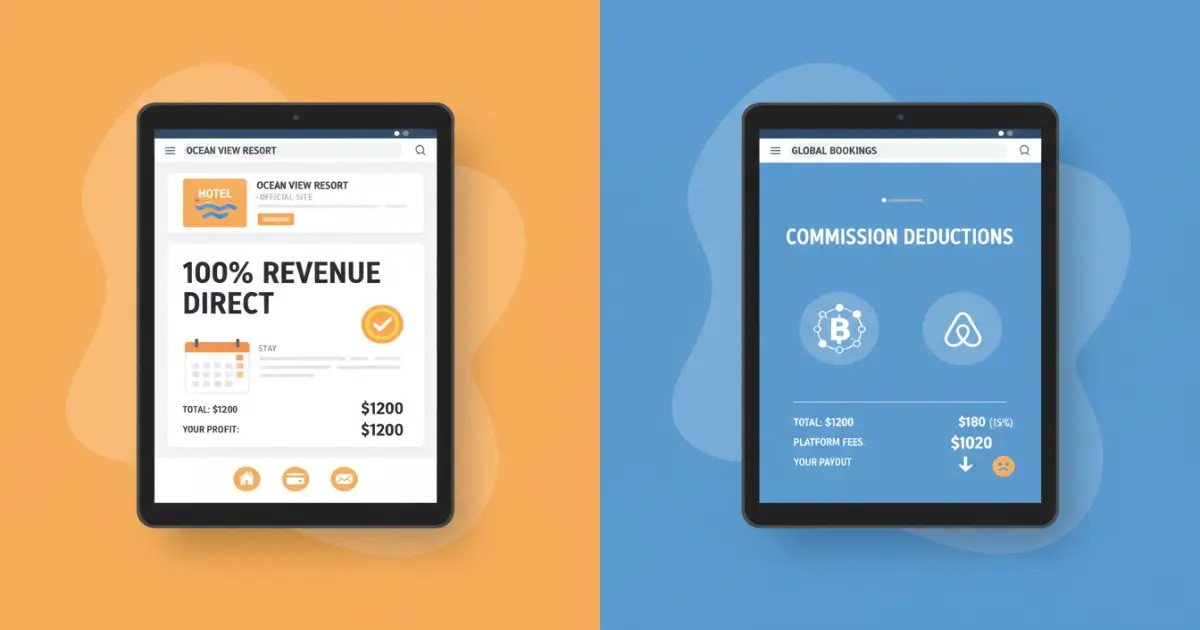
- No monthly fees for a reservation system (not Booking, not Airbnb commissions)
- Full automation of reservations and payments
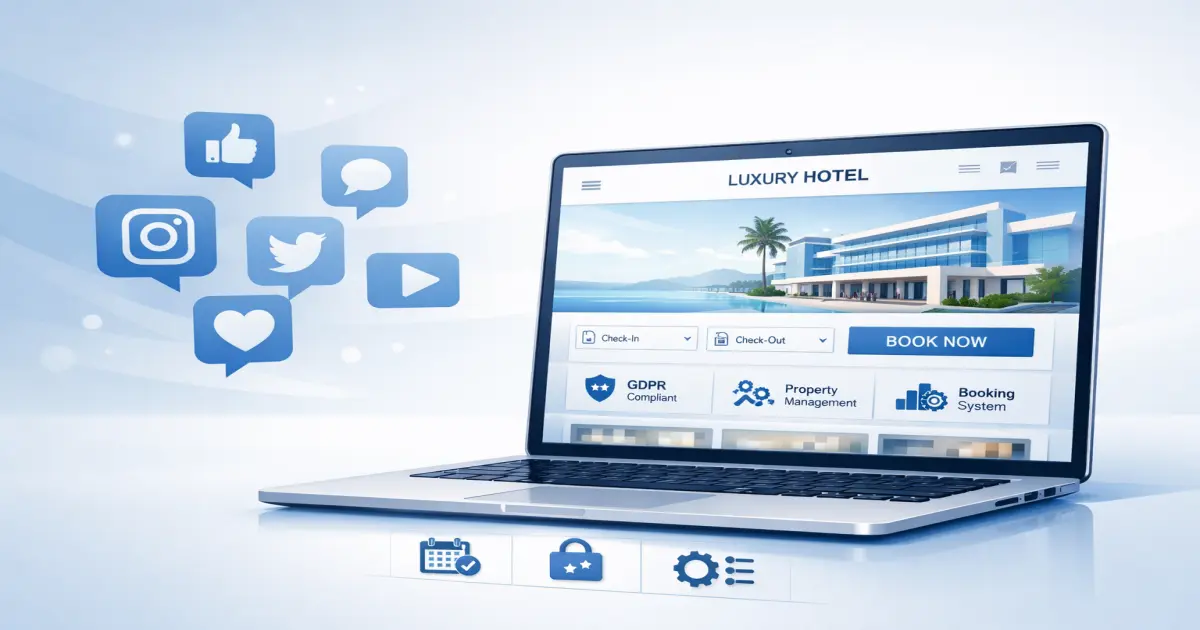
- GDPR compliance from the start
- Multilingual and multi-currency support
- SEO optimization for tourist inquiries
- Integration with Google My Business and tourist platforms
- Professional support and regular updates
"We have 5,000 followers, but no one sees the posts"
Petya manages a boutique hotel in Plovdiv. For years she worked on the Facebook page - uploading beautiful photos, writing posts, replying to comments. She reached 5,000 followers. Impressive, right?
The problem? When she uploads a post, it reaches 80-150 people. Not 5,000. Less than 3%.
This is not a mistake. It is intentional.
How social networks limit your visibility
Facebook, Instagram, and TikTok earn from ads. To make you pay for ads, they reduce organic reach (the reach of free posts). This means:
- You have 5,000 followers, but your post reaches 150 people (3% reach)
- The algorithm decides who sees the post - not you, not your followers
- If you want to reach more people, you must pay - this is called a "promoted post"
- The more followers you have, the smaller the percentage that sees them - because Facebook wants to sell ads
This is not a conspiracy. This is the business model of Meta, called "pay-to-play".
It means the following: Even if you invest years in building followers, this does not guarantee visibility. It must be bought again and again.
Your own site works the opposite way
When someone discovers your site via Google, they see:
- Everything - all rooms, services, prices, conditions
- Always - the site doesn't show only "selected posts", it shows all information
- Without competitors - in social networks, they see ads for other hotels, in the site they see only you
- Without an algorithm - no one decides whether the visitor sees room 5 or not
SEO works long-term. Once an optimized site continues to generate traffic without monthly costs. Social networks require constant payment for visibility.
The right digital strategy for a hotel
Foundation: Professional site with Hotel Manager Plugin for reservations
Supplement: Social networks for marketing and communication
Result: Sustainable business that doesn't depend on Meta's algorithms
Use Facebook and Instagram to attract attention. Use the site to turn attention into reservations.
Social networks are the display window. The site is the reception and the manager's office.
Conclusion
Social networks are great for marketing, but terrible for managing a hospitality business. Your own site is more complex to create, but it is the only sustainable and legal solution.
Social networks are temporary. The site is an investment.
Creative Idea offers a unique combination - professional creation of hotel sites PLUS an own Hotel Manager Plugin for reservation management. This is a rare opportunity to get both design and functionality from one provider.