"We have a super rating on Booking.com - 9.2! Why do we need a site?"
This is the question thousands of hoteliers, guest house owners, and apartment hosts ask themselves every day. And on the surface, the answer seems logical: Booking and Airbnb bring you reservations, so why invest in your own site?
But let's do the math.
Imagine you have 10 rooms. Average price 100 BGN per night. Over the year you have 2,000 overnight stays (average occupancy 55%). This means an annual turnover of 200,000 BGN.
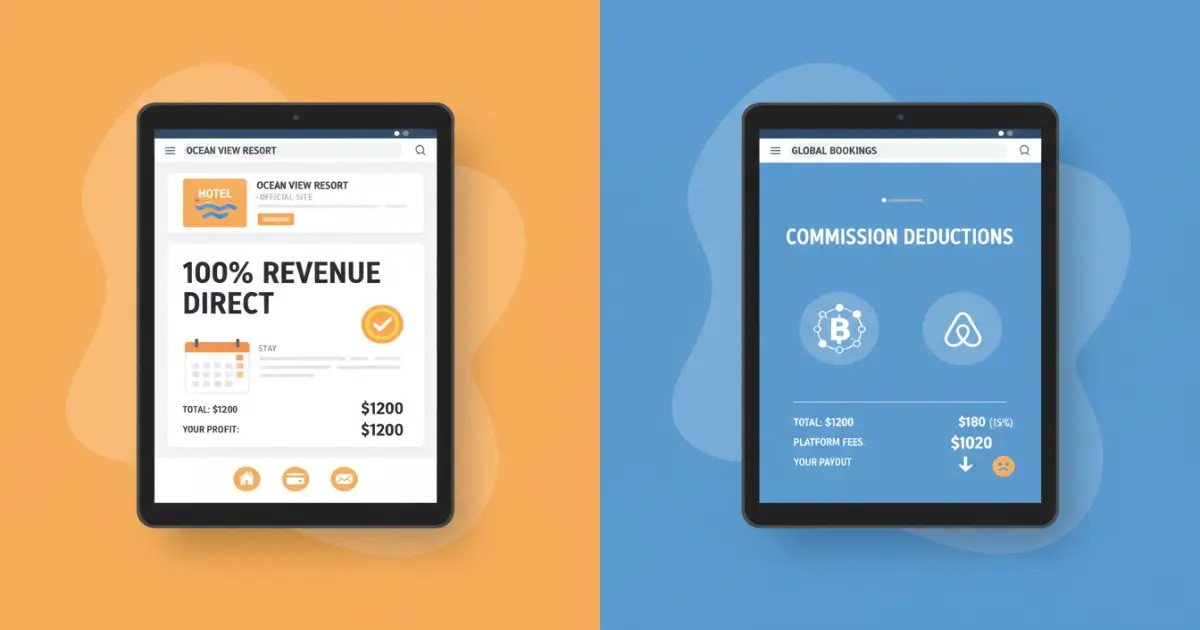
If 100% of reservations come from Booking.com with a 15% commission:
You give 30,000 BGN annually to Booking.
Over 5 years, that is 150,000 BGN. Over 10 years - 300,000 BGN.
With this money, you could have built a new building. Or done a complete reconstruction. Or hired more staff. Or invested in marketing.
But instead, you give it to an intermediary.
In this article, we will look at why Booking.com and Airbnb are useful channels, but not a business model - and why your own site is the only way to build a sustainable and profitable hospitality business.
The Mathematics of Commissions: How Much Do You Actually Pay?
Let's be specific. Booking.com and Airbnb are not charities. They are businesses that profit from your reservations.
Booking.com Commissions
- Base commission: 15% (can vary between 12-18% depending on the contract)
- Genius program: additional 10-25% discount which you give to guests (not Booking)
- Preferred Partner: additional commission for better positioning in results
- Visibility Booster: paid advertising to show up higher
The real commission is often 17-20% if everything is counted.
Airbnb Commissions
- Guest commission: 14% (the guest pays)
- Host commission: 3-5% (you pay)
- Total: around 17-19% is taken from the total reservation value
Let's calculate for a small hotel with 5 rooms
Parameters:
- 5 rooms
- Average price 80 BGN/night
- Average occupancy 60% annually = 1,095 overnight stays
- Annual turnover: 87,600 BGN
If 100% of reservations come from Booking (15% commission):
- Commission annually: 13,140 BGN
- For 5 years: 65,700 BGN
- For 10 years: 131,400 BGN
If 50% of reservations are direct (0% commission), 50% from Booking:
- Commission annually: 6,570 BGN
- For 5 years: 32,850 BGN
- For 10 years: 65,700 BGN
The difference? 65,700 BGN for 10 years. These are funds with which you can:
- Renovate all rooms
- Build a spa area
- Invest in marketing for direct reservations
- Hire more staff
- Increase the quality of service
Ownership vs. Dependency: Who Controls Your Business?
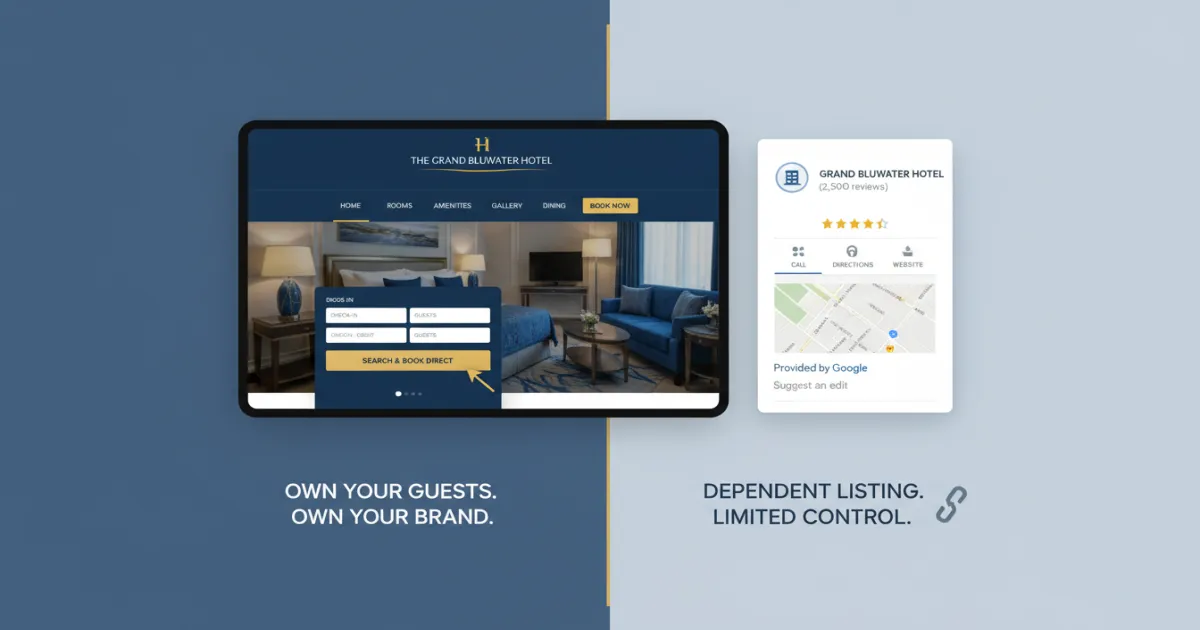
When you rely entirely on Booking.com or Airbnb, you do not control your business. They control it.
What can Booking.com do?
- Change the algorithm - your hotel suddenly appears on page 3 instead of page 1
- Increase the commission - from 15% to 18% (this has happened)
- Introduce mandatory new programs - like Genius, where you give a discount
- Impose Preferred Partner fees - pay extra or disappear from top results
- Show competitors directly next to you - and if their rating is higher, guests go to them
- Change terms - and you have no choice but to accept
What can Airbnb do?
- Change the rating system - one bad review can drop you drastically
- Suspend your profile - if a guest files a complaint (even unfairly)
- Introduce new fees - and you pay or leave
- Show similar listings - guests see 20 other apartments in the same area
What can your own website do?
Nothing. Because it is yours. You decide:
- How it looks
- What prices to set
- What promotions to run
- How to accept reservations
- Who sees the content
- How to manage the data
No one can change your terms. No one can block you. No one can take your clients.
Algorithms and Visibility: How Booking Decides Who Wins
Booking.com and Airbnb do not show hotels randomly. They use complex algorithms that decide who gets shown first.
What influences your position?
- Rating - the higher, the better
- Number of reviews - a new hotel with 10 reviews loses to an old one with 500
- Confirmation rate - if you refuse reservations, you go down
- Response time - if you answer slowly, you go down
- Preferred Partner status - pay extra, show up higher
- Genius program - give a discount, show up higher
- Visibility Booster - paid advertising for top positions
This means that even if you have a perfect hotel, unless you:
- Pay for Preferred Partner
- Give Genius discounts
- Have hundreds of reviews
- Answer within minutes
...you will be invisible.
Own website: control over visibility
With good SEO, your site can appear on the first page of Google for:
- "hotel in [your city]"
- "where to stay in [your city]"
- "[your city] accommodation"
- "hotels near [landmark]"
And when the guest clicks on your site, they see only you. No competitors. No ads. Just your hotel.
Brand and Loyalty: Booking's Guests or Your Guests?
Consider the following scenario:
A guest books with you through Booking.com. Likes the hotel. Wants to come again next year. What do they do?
Option 1: Logs into Booking, searches for your hotel, books again (you pay commission).
Option 2: Searches for your site on Google, books direct (you pay no commission).
Which is more likely?
Unfortunately - Option 1. Because:
- The guest is used to Booking
- Has a saved card there
- Has their reservation history there
- Gets Genius discounts there
- Has confirmation and guarantee from Booking
Result? You serve the same guest a second time, but pay commission again.
How does an own website build loyalty?
When a guest books through your site:
- They remember your brand, not Booking
- They receive an email directly from you
- They communicate directly with you
- They see your domain (www.yourhotel.com)
- Next time they search for you, not Booking
And even more importantly - you can:
- Send an email after the stay with thanks and a promotion
- Offer a discount for the next reservation
- Add them to a newsletter
- Build a CRM database of loyal guests
This is the difference between a temporary guest and a loyal client.
💡 Creative Idea Hotel Manager Plugin
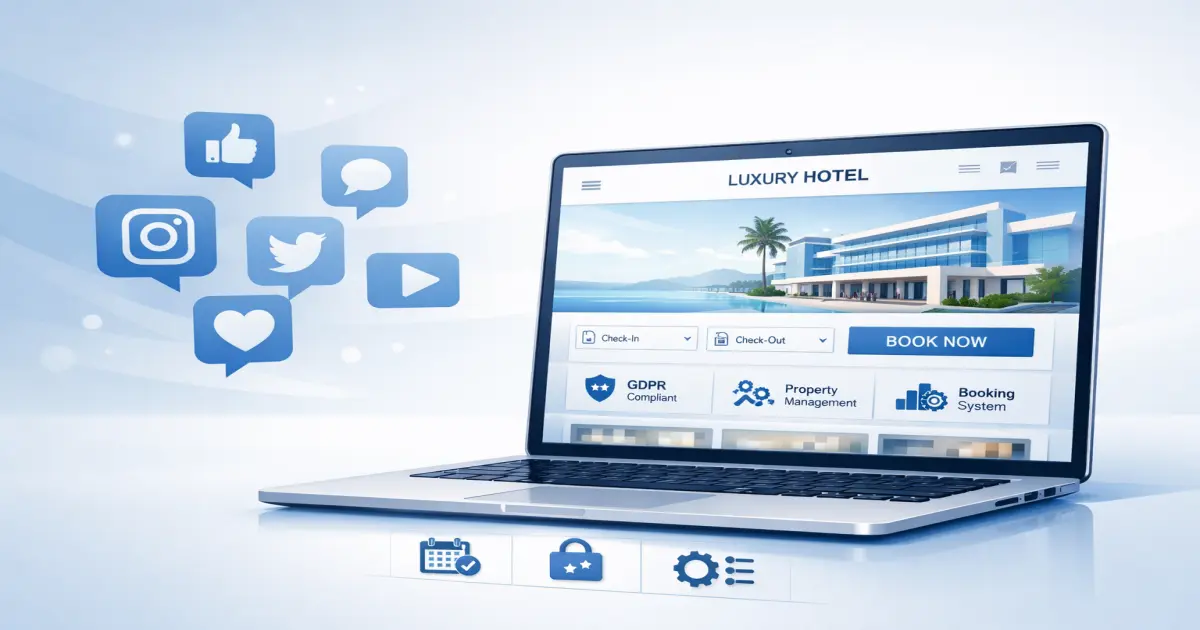
We are one of the few web agencies in Bulgaria that offer not only professional hotel website creation but also our own Hotel Manager Plugin for WordPress.
What makes it different from Booking.com:
- 0% commission - every reservation is entirely yours
- You control the process - guests send an inquiry, you decide which room to offer
- Full flexibility - you can offer 2 double rooms or 1 apartment for a family of 4 - you decide
- Automatic emails - confirmations are sent automatically after your approval
- Availability calendar - you see in real time when which room is occupied
- GDPR compliance - data is on your server, under your control
- One-time investment - $69/year (compared to 15% commission per reservation)
- Your brand - guests book from you, not an intermediary
Example: If you have 2,000 overnight stays a year at 100 BGN, you pay 30,000 BGN to Booking. With Hotel Manager Plugin you pay only $69/year. You save 29,935 BGN annually.
Data and GDPR: Whose Guests Are They - Yours or Booking's?
When a guest books via Booking.com, who owns their data?
Booking.com. Not you.
This means:
- You cannot send an email directly to the guest (without Booking's permission)
- You cannot add them to a newsletter
- You cannot offer them a direct promotion
- You cannot build a database of loyal guests
- You do not know how many times they have been with you (unless you record it manually)
Booking controls the communication. If a guest wants to write to you, they write via the Booking platform. If you want to send them an offer, you have to go through Booking.
Own website: you own the data
When a guest books via your site:
- You have their email address
- You have their phone number
- You have their reservation history
- You have their preferences (double or single room, with view or without, etc.)
- You can build a CRM database
- You can send personalized offers
- You can do remarketing
And most importantly - this is GDPR compliant, because the guest has given consent directly to you, not an intermediary.
Long-term Strategy: Building a Sustainable Business
Let's look at two strategies for a 10-year period:
Strategy 1: 100% Reliance on Booking.com
Year 1:
- You get many reservations (Booking has huge traffic)
- You pay 15% commission
- You build a rating
Year 5:
- You have already paid over 60,000 BGN in commissions
- Booking increases commission to 17%
- They introduce the Genius program - you have to give discounts
- Competition grows - there are 20 new hotels in the area
- Your position in results drops
Year 10:
- You have paid over 150,000 BGN in commissions
- You still depend on the Booking algorithm
- You have no direct reservations
- You have no guest database
- You have no brand outside of Booking
- If Booking changes conditions - you have no choice
Strategy 2: Own Website + Booking as an Additional Channel
Year 1:
- You invest 3,000 BGN in a professional site + Hotel Manager Plugin
- 70% reservations from Booking, 30% direct
- You start building a guest database
Year 5:
- 50% reservations from Booking, 50% direct
- You have 500+ guests in the CRM database
- You have a Google rating + reviews on the site
- Your site ranks on the first page for local searches
- You have saved 30,000+ BGN in commissions
Year 10:
- 30% reservations from Booking, 70% direct
- You have 2,000+ guests in the database
- You have strong local SEO
- You have an established brand
- You have saved 100,000+ BGN in commissions
- If Booking changes conditions - it's not a problem, because you don't depend on them
Which strategy is more sustainable?
Conclusion: Booking is a Channel, Not a Business Model
Let's be clear: Booking.com and Airbnb are not enemies. They are useful channels for:
- Visibility
- Access to an international audience
- Easy start for a new hotel
- Additional traffic
But they cannot be your only channel, because:
- Commissions destroy profitability
- You do not control your business
- You don't build a brand
- You don't build a loyal guest base
- You depend on algorithms that change
- Long-term you pay hundreds of thousands for reservations that could have been free
Your own site gives you:
- 0% commission - every reservation is entirely yours
- Full control - you decide everything
- Brand - guests remember you, not Booking
- Loyalty - you build a base of repeating guests
- Data - you own the guest information
- Sustainability - you don't depend on a foreign platform
The right strategy is:
Own website as a base + Booking/Airbnb as additional channels
Use Booking for visibility. But build your business on land that you own.
Because the commissions you pay today are investments you could have made tomorrow.