"We have a Google Business Profile with 4.8 stars and 200 reviews. Do we need a site?"
This is the question many owners of hotels, guest houses, and apartments ask themselves. And on the surface, the answer seems logical: if people find you on Google, why invest in a site?
But the reality is different.
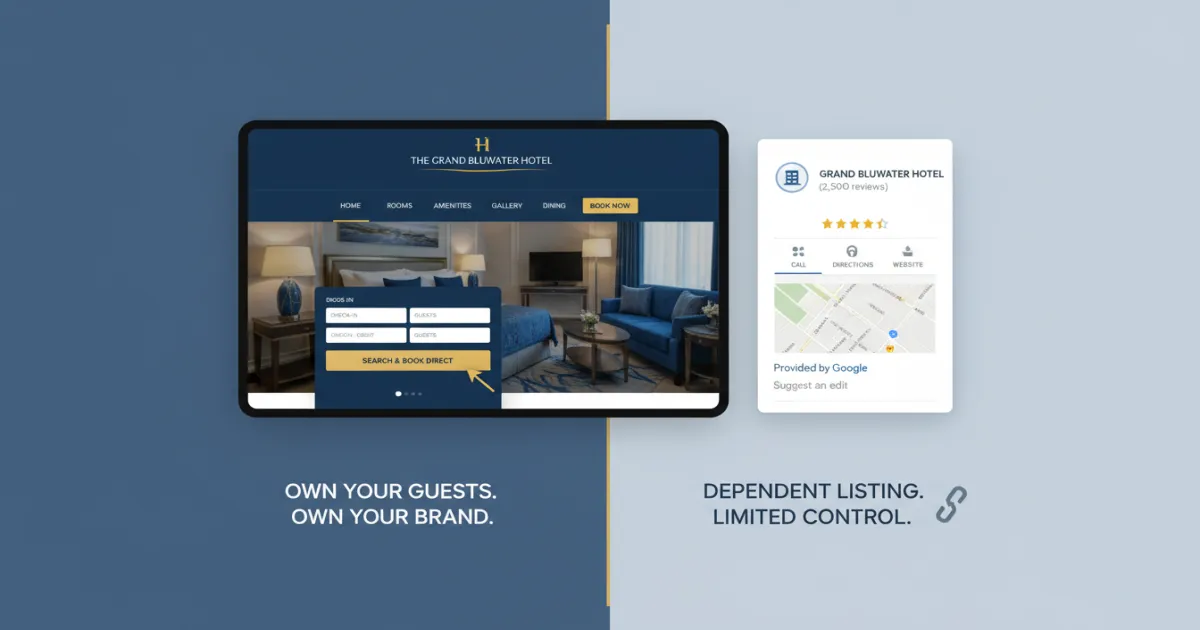
Google Business Profile is a display window. TripAdvisor is a catalog. Local directories are a directory. They are useful for visibility, but they are not your business. They are rent, not ownership.
Your own site is the reception. This is the place where guests book, the platform you control, the asset you own.
In this article, we will look at why listing platforms cannot replace an own site - and why the combination of both is the right strategy for a sustainable hospitality business.
Ownership vs Rent: The fundamental difference
Imagine you have two options for a physical store:
- Option 1: You buy your own store on a central street. You choose the design, the window, the interior, the working hours, the promotions. No one can evict you or change the conditions.
- Option 2: You rent a booth in a mall where there are 50 other similar businesses. The malls decide the hours, the rules, the design. They can increase the rent, put a competitor next to you, or even evict you if they decide.
Which option is more sustainable long-term?
This is exactly the difference between an own site and listing platforms.
Own site = Ownership
When you have an own site:
- The domain is yours (www.yourhotel.com)
- The content is yours
- The design is yours
- The data is yours
- The functionalities are yours
- No one can block, restrict, or remove you
Listing platform = Rent
When you rely only on Google Business Profile, TripAdvisor, or local directories:
- The profile is not yours - it belongs to the platform
- The content is limited - you only have the fields the platform allows
- The design is the same for everyone
- The algorithm decides who sees your profile
- The platform can change the rules at any time
- Competitors are shown next to you
This doesn't mean listing platforms are bad - on the contrary, they are very useful. But they cannot be the only digital presence you have.
Content control: Limited fields vs unlimited possibilities
Open the Google Business Profile of your hotel. What can you change?
- Business name (limited to the real name)
- Address
- Phone
- Working hours
- Several photos
- Description (up to 750 characters)
- Category
This is all. You cannot:
- Add a detailed description of the rooms
- Upload a virtual tour
- Show detailed prices
- Explain special offers
- Tell the story of the hotel
- Show the surroundings and attractions
- Integrate an online reservation system
- Publish blog posts about the region
Now open your own hotel site. What can you do?
- Unlimited number of pages
- Detailed description of each room with galleries
- Virtual tour and 360° photos
- Detailed price tables
- Special packages and promotions
- History of the hotel
- Guide to the surroundings
- Online reservation system
- Blog with tourist tips
- Multilingual version
- SEO optimization
- Customized design reflecting the brand
The difference is obvious. Listing platforms give you a business card. The site gives you an encyclopedia.
SEO: Who builds authority - you or the platform?
Let's look at what happens when someone searches for "hotel in Bansko" in Google:
If you rely only on Google Business Profile:
- Your profile shows in the local results (map)
- Next to you, 10+ competitors are shown
- Google decides who to show first (based on reviews, proximity, relevance)
- The guest sees limited information
- Google builds authority as a platform, not you as a hotel
If you have an own site:
- Your site can show in organic results
- You can rank for "hotel in Bansko", "where to stay in Bansko", "hotels near Bansko ski slopes"
- You can publish blog posts like "Top 10 things to do in Bansko in winter" that attract traffic
- You can optimize each page for different keywords
- You build authority as a brand
The algorithm of listing platforms works for them, not for you
Google Business Profile, TripAdvisor, and local directories are optimized to:
- Attract traffic to their platform
- Show ads
- Show competitors
- Keep guests on their page (not redirecting them to your site)
Your site is optimized to:
- Attract traffic directly to you
- Build your brand authority
- Show only your rooms, services, offers
- Turn visitors into reservations without distraction
Brand and identity: Same profiles vs unique experience
Open TripAdvisor. Look at 5 different hotels. Do you notice anything?
They all look the same. Same structure, same sections, same design. The only difference is the photos and the text.
This is not accidental. Listing platforms are created to:
- Facilitate comparison between businesses
- Standardize information
- Make everyone look the same, to encourage competition
But what happens when everyone looks the same? The guest chooses based only on:
- Price (who is cheapest)
- Rating (who has the most stars)
- Location (who is closest)
Your unique atmosphere, your story, your attitude - all this disappears.
Your own site tells your story
Imagine two hotels in Koprivshtitsa:
Hotel A is a Revival-era house from 1850, restored with authentic materials. The landlady is a local who cooks traditional recipes from her grandmother.
Hotel B is a modern building with minimalist design, spa center, and contemporary interior.
Both hotels have 4 stars on Google. Both are 5 minutes from the center. Both have 20 rooms.
But they are completely different. How to convey this difference in 750 characters on Google Business Profile?
You cannot.
In your own site you can:
- Show a photo gallery of the restoration process
- Tell the story of the house
- Present grandmother's recipes
- Create an atmosphere with design, colors, fonts
- Publish a video with the interior
- Write blog posts about Revival architecture
This is the difference between a listing and a brand.
GDPR and data control: Foreign servers vs your hosting
When a guest writes to you via Google Business Profile or another listing platform, where is their data stored?
On the platform's servers. Not yours. You have no control.
GDPR (General Data Protection Regulation) requires:
- Clear information on where data is stored
- Possibility to delete data upon client request
- Possibility to provide a copy of the data
- Control over who has access to the data
- Logs of data processing
How can you fulfill this if the data is on Google/TripAdvisor/local directory?
Listing platforms: you have no control
- Data is stored on servers outside the EU
- You don't know who has access
- You cannot delete data upon client request
- You cannot provide a copy
- You cannot manage cookies
Own site: full control
- You choose the hosting company (can be EU-based)
- You control where data is stored
- You can delete data
- You can provide copies
- You can manage cookies and policies
- You have logs of all actions
For a European hospitality business, this is not a small detail - this is a legal obligation.
💡 Creative Idea Hotel Manager Plugin
We are one of the few web agencies in Bulgaria that offer not only professional creation of hotel sites, but also an own Hotel Manager Plugin for WordPress.
What makes it different from listing platforms:
- Full control - you decide how to manage reservations
- Flexible system - guests send inquiry, you choose which room to offer
- Calendar with availability - you see in real-time when which room is occupied
- Automatic emails - confirmations are sent automatically after your approval
- GDPR compliance - data is on your server, under your control
- No monthly fees - one-time investment of $69/year
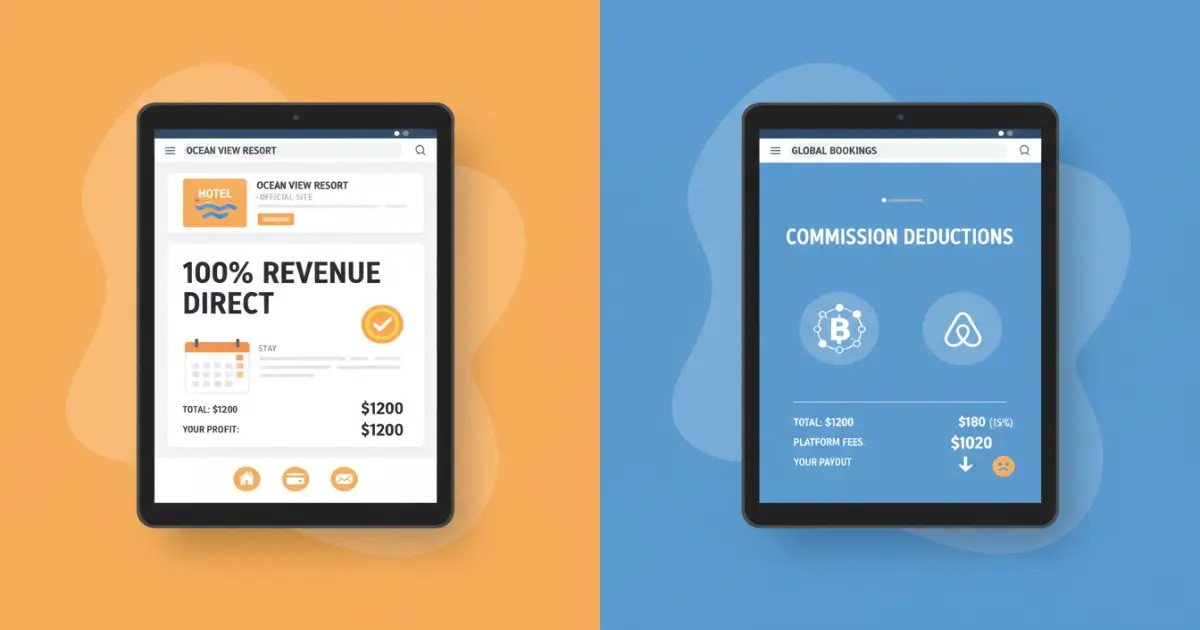
- No commissions - every reservation is yours, without intermediary percentage
Functionalities: Limited fields vs endless possibilities
Imagine you want to add an online reservation system. Can you do it in Google Business Profile?
No. You can only place a link to an external platform (like Booking.com, which means commissions).
What else can you not do in listing platforms:
- Online reservations
- Online payments
- Custom forms
- Blog
- Full multilingual version
- SEO optimization of content
- Automatic emails
- CRM integrations
- Automations
- Customized design
In your own site, you can add all this - and much more.
Long-term sustainability: Temporary presence vs strategic asset
Let's see what happens after 5 years:
Only listing platforms (without own site)
- You still depend on algorithms that change
- You still have competitors shown next to you
- You still have no control over the design
- You still have no direct reservations (without commissions)
- You still have no full history of guests
- You still have no brand identity
Own site + listing platforms (combination)
- You have built SEO authority for dozens of keywords
- You have a blog with 50+ posts that attract organic traffic
- You have a database of guests who book directly (without commissions)
- You have an automated reservation system
- You have a unique brand that stands out
- You have full control over data and functionalities
- Listing platforms give you additional visibility, but you don't depend only on them
Which strategy is more sustainable?
Conclusion: Listing platforms are useful, but the site is the foundation
This is not a question of "either/or". This is a question of "and/and".
Google Business Profile, TripAdvisor, and local directories are very useful for:
- Local visibility
- Social proof (reviews)
- Additional traffic
- Discoverability
But they cannot replace an own site that gives you:
- Ownership and control
- Unlimited content
- SEO authority
- Brand identity
- GDPR compliance
- Online reservations without commissions
- Automation
- Long-term sustainability
Listing platforms are a display window. The site is the reception.
Listing platforms give visibility. The site gives identity.
Listing platforms are temporary. The site is an investment.
Use both. But always remember: your own site is the foundation, listing platforms are a supplement.