For many businesses Black Friday is the most important day of the year. Phone deals, PlayStation deals, furniture deals, TVs, clothes and cosmetics - in a few days stores sell as much as in a whole month. The price is the margin: the retailer earns less on every sale but counts on making many more sales.
That only works if everything works. If the site goes down exactly when people are ready to pay, the discount is given, the ads are paid for, and the sales are gone. In this article we go through everything that can go wrong - for online store owners and for shoppers - and how to prepare.
What is a “successful Black Friday”, really?
Most owners measure success with one number: revenue. But revenue can break a record and the day can still be a failure. If half the orders come back, if you sold stock you do not have, or if customers wait three weeks for their parcel and never buy from you again, the record exists only on paper.
A successful Black Friday for an online store looks like this:
Signs of a truly successful Black Friday
- The site stays fast all day, including in the busiest minutes
- Cart and checkout work without errors, double charges or “stuck” orders
- Stock levels are correct - you do not sell something that has already run out
- Confirmation emails arrive instantly, not hours later (or in spam)
- Parcels ship on the promised date and the customer knows when to expect them
- After discounts, couriers, ads and returns, there is still a profit
- Some of the new customers come back for Christmas and after it
The margin maths: how much more you need to sell
Take a simple example. A product sells for €100, it costs you €60, so you earn €40 per unit. You put it on a 30% Black Friday discount - now it is €70 and your profit is €10.
To earn the same money as on a normal day you need to sell four times as many units. And four times the orders means four times the packing, four times the phone calls, four times the returns (online buyers have 14 days to withdraw) and four times the load on the website.
That is why Black Friday is not just “we put on red labels”. It is an operation you prepare for weeks in advance. If you cannot handle the volume, it is better to give a smaller discount on fewer products and deliver them flawlessly.
You pay the discount for sure. You only get the extra sales if the website, the warehouse and the courier hold up.
- Creative Idea
10,000 visits a day is not 416 an hour
This is the biggest misunderstanding we see among online store owners. The maths looks logical: “We expect 10,000 visits on the day. Divided by 24 hours, that is about 416 an hour, or 7 people a minute. Our hosting will cope.”
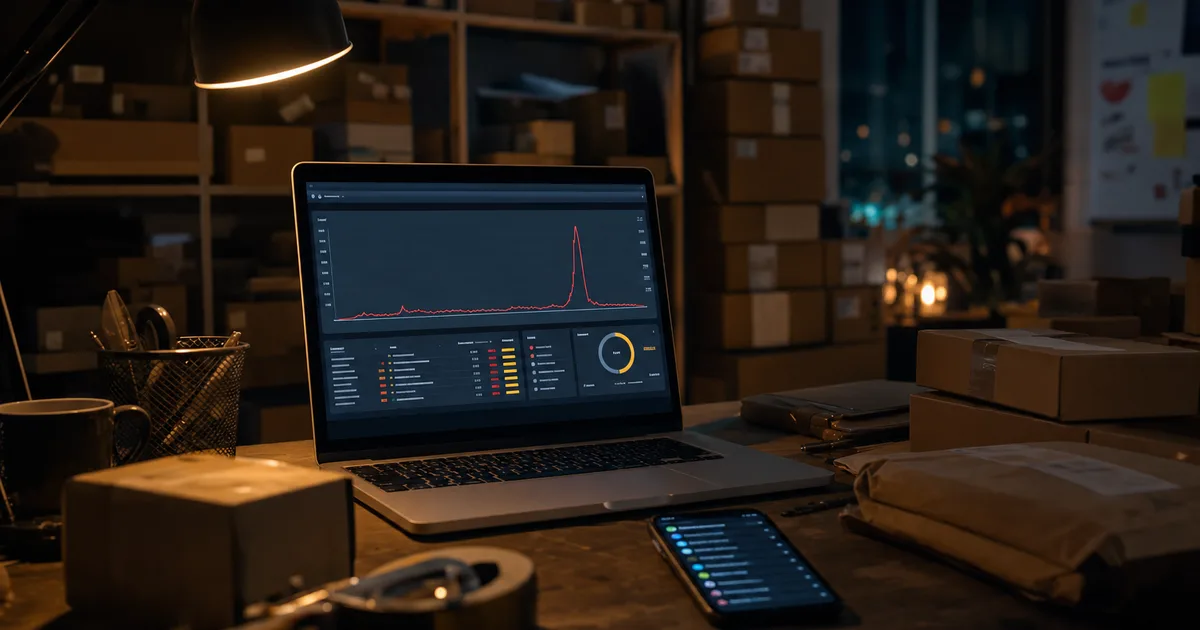
But people do not shop evenly. At 4 am there is almost nobody on the site. At 00:00 when the sale starts, during the lunch break and in the evening between 20:00 and 23:00, a huge share of visitors arrives. The real picture looks more like this:
How 10,000 visits are spread over a real Black Friday
- 00:00 - 01:00: the sale starts, about 1,500 people. The first 10 minutes are the hardest - people have been waiting and come in at once
- 01:00 - 07:00: almost quiet, a few hundred visits in total
- 12:00 - 14:00: lunch break, about 1,500 people on their phones
- 20:00 - 23:00: the evening peak, about 3,000 - 3,500 people
- Peak minute: not 7, but 200, 300 or more people on the site at the same time
And that is not all. One visit is not one request to the server. A person opens the home page, a category, filters by price, opens five products, goes back, adds to cart, checks delivery, pays. That is dozens of requests, and some of them - search, filters, cart and checkout - are the heaviest, because they cannot be cached and hit the database every time.
So the hosting does not need to survive the “average” hour. It needs to survive the worst minute. A site that runs perfectly with 20 people at once can freeze completely at 300.
Black Friday ads: traffic arrives in waves
If you run Black Friday ads on TV or radio, or send a newsletter to 50,000 subscribers, traffic does not arrive smoothly. It arrives as a hit. The ad ends and in the next 2-3 minutes hundreds of people reach for their phones and type in your address. The same happens when an influencer posts your promo code, or when the newsletter lands in every inbox at once.
A TV ad is the most expensive traffic you can buy. If the site does not respond in exactly those minutes, you have paid to show thousands of people an error page. Most of them will not try twice - they will go to the competitor whose ad ran before or after yours.
How to handle ad waves
- Tell whoever maintains your site exactly when the ads and newsletters go out
- Send emails in several batches 15-30 minutes apart instead of to everyone at once
- Point the ad to a light, cached promo page, not to the site search
- Watch the site live while the ad runs, not the next morning
The lesson from the first Black Friday in Bulgaria
The first Black Friday in Bulgaria was run by eMAG in 2013. Interest was so high and people were so eager for the deals that the site could not cope and was unavailable at times. And this is a company with a technical team and infrastructure that a small online store does not have. Capital tells the story of how the campaign became the most important day for the company in “The eMAG Friday” (in Bulgarian).
Since then the big players prepare months in advance: extra servers, load tests, a “waiting room” for visitors when the site is full. A small store does not need all of that, but it needs the same thinking: the load will come all at once and you have to be ready before it.
What breaks first in an online store
When a store “goes down” on Black Friday it is rarely just one thing. It is usually a chain: a slow database holds requests, they pile up, the server runs out of memory and stops responding. These are the most common weak points:
The most common technical problems
- Shared hosting with limits. Cheap hosting shares the server with dozens of other sites and caps the number of processes. At the peak, requests simply wait or get a 503/508 error
- A slow database. Thousands of products, old orders, unoptimised tables - every search and filter gets slower and slower
- Too many plugins. In WooCommerce every plugin adds work to every page. 40 plugins with 300 people at once is a serious problem
- Heavy images and scripts. 3 MB photos, chats, pixels, animations and videos slow the site down, especially on phones and mobile data
- Cart and checkout. They cannot be cached, so they take the heaviest load exactly at the moment of purchase
- Sending emails. Hosting limits emails per hour. Hundreds of order confirmations can use it up, and the emails arrive late or land in spam
- Stock sync. If the warehouse and the site do not update in real time, you sell stock that is already gone
- Third-party services. The payment provider, courier integration or accounting system are under load too and can respond slowly
- Bots and attacks. Around big sales there are more price-scraping bots and attack attempts. They eat resources meant for real customers
Mistakes that are not technical but cost just as much
Not every Black Friday failure comes from the server. Some of the most expensive mistakes are in the settings:
- A wrong price. One missing zero and the phone costs €10 instead of €1,000. The screenshot is all over Facebook within the hour
- Stacking coupons. A promo code plus a category discount plus a sign-up discount, and the product goes out for almost nothing
- The sale does not start or stop on time. The site time zone differs from the real one and prices change at 02:00 instead of 00:00
- Unclear terms. It does not say when the sale ends, how much delivery costs and when the parcel will arrive - and the phone never stops
- Last-minute changes. A new plugin or theme uploaded on Thursday evening without testing. That is the surest way to have a problem on Friday
Preparation: a week-by-week plan
The best time to prepare for Black Friday is a month before it. The second best time is now. Here is a realistic plan for a small or medium online store:
4-6 weeks before
- Check what hosting you have and how many simultaneous visitors the site can really handle
- Run a load test to find the limit before your customers find it
- If needed, move to a VPS or temporarily increase resources for November and December
- Enable caching and a CDN (for example Cloudflare) for images, styles and pages
- Optimise images (WebP, correct sizes) and remove unnecessary plugins and scripts
- Clean up and optimise the database
- Agree extra pickups with your courier and check their delivery times for the peak period
1-2 weeks before
- Prepare sale prices in advance and have two people check every single one
- Test the whole purchase: on a phone, by card, cash on delivery, with a coupon
- Check that confirmation emails arrive and do not go to spam
- Update stock levels and prepare packaging in advance
- State clearly on the site: sale period, delivery time, return conditions
- Take a full backup of the site and the database
- Announce a “freeze”: no new plugins, themes or changes until the sales are over
On the day
- Someone watches the site live during peak hours and knows what to do if it slows down
- You have the phone number of your hosting and of whoever maintains the site
- You have a ready message for social media in case of a short outage
- You watch for orders with payment problems and for sold-out products
- You reply to messages fast - on this day people buy from whoever answers first
After Black Friday
- Compare real profit (not revenue) with the same period without sales
- Look at when the peaks were and what was slow - that is your Christmas preparation
- Handle returns quickly and politely - they decide whether the customer comes back
- Write to new customers about your Christmas offers
It is not only Black Friday
The same load comes on other days too: Cyber Monday, 11.11, the weeks before Christmas, Valentine’s Day, Women’s Day, Easter, back to school. If your site is prepared properly once, it is ready for all of them. If not, every promo day is a lottery.
The Christmas season in particular is longer and more exhausting than Black Friday. The load lasts not one day but three or four weeks, and in the last week before Christmas the couriers are already at their limit. A store that is fast, clear and honest about when the parcel will arrive earns trust that stays after the holidays. We explain how caching works and why it makes a site faster in a separate article.
For shoppers: how to spot a real deal
Black Friday is a great time to buy, if you know what you are doing. The problem is that some retailers use an unfair practice: two or three weeks before Black Friday they raise prices, and then “cut” them by 30-40%. The final price turns out very close to the usual one, sometimes the same. The big red percentage is just for show.
This is not just theory. Right after the first Black Friday in Bulgaria, the Commission for Protection of Competition fined the owner of eMAG more than 550,000 leva over its 2013 campaign. According to the Commission, the slogans “the day with the most and biggest discounts of the year” and “only today you get the most and biggest discounts” misled customers about how the final price was formed (bTV, in Bulgarian).
A year later the story repeated on a bigger scale. For campaigns in 2014, including Black Friday on 28 November, the Commission imposed fines totalling 4.6 million leva on the owner of eMAG and two publishing houses. The Commission found the campaigns misleading about the final prices of promotional products and about how those prices were formed and presented. The company that filed the complaint claimed prices had been raised in advance and then “cut” by up to 70%. eMAG denied offering products at inflated prices, and the decision could be appealed (Investor.bg, in Bulgarian).
You do not need to know who is right in a particular case. It is enough to know the price before the sale.
So the best thing you can do is start tracking prices now.
How not to fall for a fake discount
- Make a list of the things you really want - a phone, a console, a piece of furniture - and write down their prices today
- Take dated screenshots: that way you will see whether the Black Friday “old price” is real
- Use price comparison sites that show price history
- Under EU rules, when a discount is announced the retailer must show its lowest price from the last 30 days. If it is missing or looks odd, be careful
- Compare the price in several stores, not just the one that showed you an ad
- Do not buy under the pressure of a “2 hours left” or “only 3 left” counter - they often come back
- If you suspect a misleading sale, you can report it to the consumer protection authority
Watch out for fake stores and fake messages
Scammers are most active around big sales. Sites appear with incredible phone deals and PlayStation at half price, Facebook ads for stores that have existed for two weeks, and texts saying “Your parcel is waiting, pay €1 for delivery”. They all count on the fact that in these days we are all expecting parcels and in a hurry.
- Check who is behind the store: company, registration number, address, phone, reviews outside the site itself
- A price half of what it is everywhere else is almost always a scam
- Do not open links in texts and emails about “unpaid delivery” - go to the courier site yourself
- Pay by card or cash on delivery, not by bank transfer to strangers
We explain in detail how to recognise a scam store built with AI in our article about fake AI stores.
When the system gets it wrong: double payment, missing email, sold-out product
On busy days errors happen even at good stores. The key is not to make them worse:
- Payment “stuck”? Do not press “Pay” five more times. Check your banking app to see whether the amount is held, and wait for an email or contact the store
- No confirmation email? Check the Spam and Promotions folders. At peak hours emails are sometimes late
- The product turned out to be sold out after you ordered? This happens when hundreds of people buy the same thing in the same minute. A fair store will refund you at once or offer an alternative
- Changed your mind? For online purchases you have 14 days to withdraw, with some exceptions such as made-to-order goods
Couriers: the busiest people in November and December
During Black Friday and the Christmas holidays people shop online en masse. Courier companies handle many times more parcels than usual, with the same warehouses, vans and people. Delays are almost unavoidable, especially in the week after Black Friday and the last days before Christmas.
So our advice to shoppers is twofold. First, before you order, check the delivery terms and times - especially if you are buying a gift that has to arrive by a certain date. Many stores announce a last order date for delivery before Christmas. Second, be understanding if a parcel is a day or two late. The courier calling you at 19:30 has probably delivered twice as many parcels as usual.
For owners: how to reduce delivery problems
- State a realistic delivery time, not the most optimistic one
- Announce a clear last order date for delivery before Christmas
- Pack and hand over parcels every day instead of piling them up for the end of the week
- Send the customer a tracking number as soon as the parcel ships
- Offer more than one courier, or delivery to a locker or office, which are less busy
- Tell the customer first if there is a delay, before they have to contact you
Want your store to survive Black Friday and Christmas?
If you have an online store and want to prepare for Black Friday as well as the Christmas holidays and every other promo day, contact us for a consultation. We will look at your site and server, tell you where the weak points are and share ideas for improving them: from caching and image optimisation to more powerful hosting for the busy months.
Get in touch - the sooner, the more we can do before the peak. And if you are only thinking about your own online store, work out the price here.